
Alexandr Wang Net Worth: How a 28-Year-Old Built a $3.6 Billion AI Empire
Let’s talk about the Alexandr Wang net worth. If you’re in the tech or finance world, this is the name that’s been dominating every headline, and for good reason. We are living through an AI gold rush, a complete paradigm shift that feels bigger than the internet itself. And in this gold rush, most people are focused on the “gold”—the flashy AI models like OpenAI’s.
But Alexandr Wang? He did something, in my opinion, infinitely smarter. He sold the picks and shovels.
As of November 2025, Alexandr Wang’s net worth is estimated to be a staggering $3.2 billion to $3.6 billion.
This makes him, at 28 years old, one of the youngest—and until very recently, the youngest—self-made billionaires on the planet. (He was just dethroned in November 2025 by a trio of 22-year-olds from Mercor, but that’s another story!)
How does a 19-year-old kid drop out of MIT and, in less than a decade, build a company that becomes the literal backbone of the entire AI industry? I believe Wang’s story is far more impressive than Mark Zuckerberg’s. Why? Because Zuckerberg connected people. Wang is building the engine that powers artificial thought.
This isn’t just a story about money; it’s a story about vision. Let’s dig in.
Alexandr Wang’s Financial Snapshot (2025)
| Metric | Detail |
| Full Legal Name | Alexandr R. Wang |
| Estimated Net Worth | $3.2 Billion – $3.6 Billion USD |
| Primary Income Source | 14-15% Stake in Scale AI |
| Company | Scale AI (Co-founder) |
| Company Valuation | $13.8B (May 2024) – $29B (June 2025 Meta deal) |
| Date of Birth | 1997 |
| Age (as of 2025) | 28 |
| Key Title | World’s Youngest Self-Made Billionaire (at age 24) |
| Education | Massachusetts Institute of Technology (MIT) – Dropout |
The Origin Story: The Prodigy Who Saw a Problem
You can’t understand Wang’s wealth without understanding his background. He wasn’t just “good with computers.” He was a prodigy. His parents were physicists working on military projects at Los Alamos National Laboratory—the very place that birthed the atomic bomb. If you ask me, growing up in an environment of intense, world-changing science hard-wires your brain to think on a different scale.
He was competing in math and programming Olympiads in high school. By 17, he was working full-time as an engineer at the Q&A site Quora. At Quora, he met his future co-founder, Lucy Guo.
He then went to MIT to study… what else?… artificial intelligence. And that’s where he hit the wall that would make him a billionaire.
The “Aha!” Moment at MIT
While at MIT, Wang realized something that I believe is the core of his entire success. Everyone was obsessed with building better AI algorithms (the “brain”). But the algorithms were useless without good data (the “textbooks”).
It’s like having the world’s most powerful engine but no fuel.
The “fuel” for AI is clean, labeled, high-quality data. And in 2016, getting that data was a nightmare. It was messy, expensive, and slow. Companies were wasting 80% of their time just cleaning data before they could even start the “sexy” work of building AI.
Dropping Out to Found Scale AI
Wang’s big idea was simple: What if he built the “picks and shovels” for the AI gold rush? What if he built a company that did nothing but supply the fuel?
At 19, he dropped out of MIT, teamed up with Lucy Guo, and joined the Y Combinator startup accelerator to found Scale AI. In my opinion, dropping out of MIT takes a level of confidence that most of us can’t even imagine. He wasn’t just betting on an idea; he was betting everything on himself.
What is Scale AI? The $29 Billion “Picks and Shovels”
So what is this “fuel” business? It sounds boring, right?
Wrong. It’s the single most critical component.
What Does “Data Labeling” Even Mean?
Imagine you’re teaching an AI to recognize a “stop sign” for a self-driving car. You need to show it millions of pictures. But you can’t just dump photos from Google Images.
- A human (or AI-assisted human) has to draw a box around every single stop sign.
- They have to label it: “stop sign.”
- They have to do this for signs in the rain, at night, behind a tree, and halfway cut off.This “data labeling” is what Scale AI does, but on an unimaginable… well… scale.
Scale AI built a platform that combines human labor (a massive global workforce) with AI assistance to label text, images, and voice data at superhuman speeds.
Who Buys This “Fuel”? (Hint: Everyone)
This is the brilliant part. Wang didn’t tie his company to one industry. Everyone building serious AI needs his service.
Scale AI’s client list is a “who’s who” of planet Earth:
- AI Labs: OpenAI (the makers of ChatGPT), Anthropic, Google DeepMind
- The U.S. Government: The Department of Defense, U.S. Army
- Automotive: General Motors, Toyota
- Tech & E-commerce: Meta, Microsoft, Nvidia, Etsy, Pinterest, PayPal
My Opinion: The Smartest Business Model in Tech
He built an invisible utility. Scale AI is the water company, the power grid. You don’t see it, but nothing works without it. I believe this “infrastructure” play is the single smartest business model of the last decade. While everyone else fought over who had the “smartest AI,” Wang simply made himself essential to all of them.
The Valuation Ladder: How Alexandr Wang’s Net Worth Exploded
A CEO’s net worth is just paper until the company has a valuation. Wang’s 14-15% stake in Scale AI went from “monopoly money” to “real billions” through a dizzying series of funding rounds.
The Unicorn Round (2019-2021)
Scale AI raised $100 million in its Series C round in 2019. This pushed its valuation over $1 billion. It was officially a “unicorn,” and Wang was, on paper, a centi-millionaire.
But it didn’t stop. In 2020, a Series D round valued it at $3.5 billion.
Becoming the World’s Youngest Self-Made Billionaire
The big one hit in 2021. A Series E round raised $325 million, valuing the company at an incredible $7.3 billion.
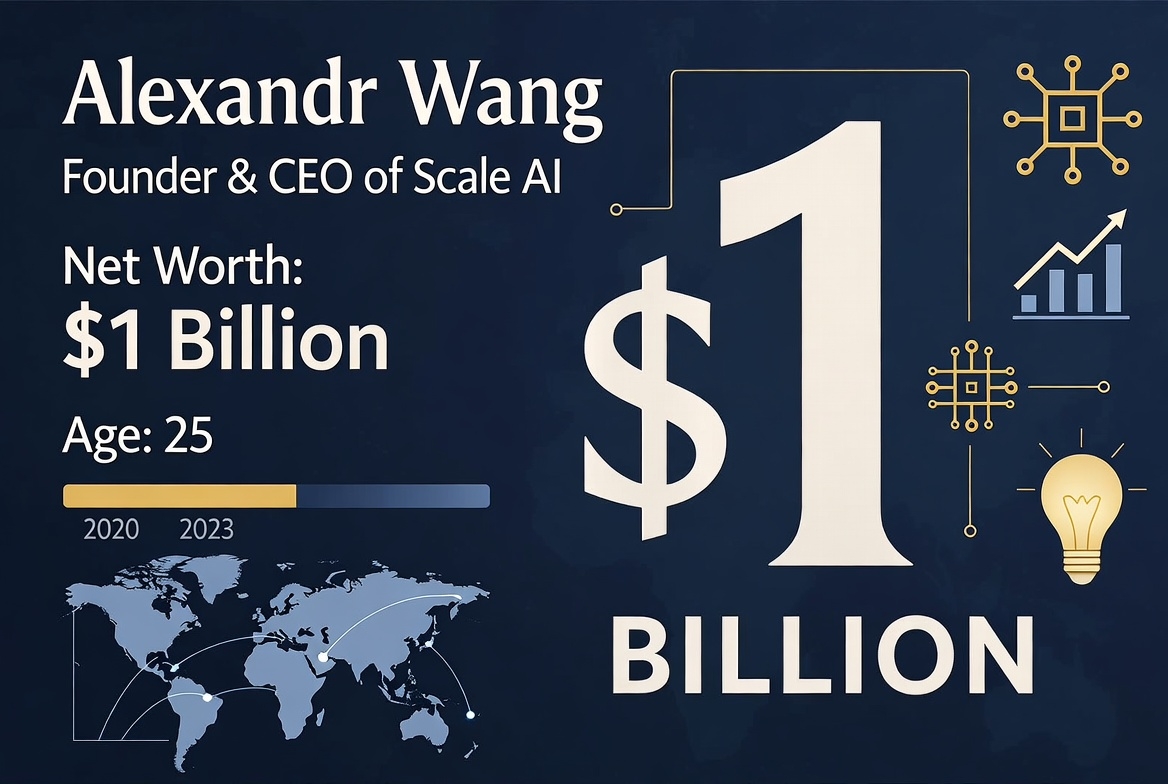
At just 24 years old, Wang’s 15% stake was suddenly worth over $1 billion. He was officially crowned the world’s youngest self-made billionaire. If you ask me, this milestone is more impressive than Zuckerberg’s because he built a B2B (business-to-business) company, which is notoriously harder to scale than a social media app.
The $1 Billion Funding Round (May 2024)
Just when you thought it couldn’t get crazier, it did. In May 2024, Scale AI raised $1 BILLION in a single Series F round. This round included tech giants like Meta, Amazon, and Nvidia. The valuation doubled to $13.8 billion.
At this point, Wang’s 14% stake was worth nearly $2 billion. But the story doesn’t end there.
The Meta Deal: The $14 Billion Kingmaker Moment of 2025
The Alexandr Wang net worth story has a new, seismic chapter that just unfolded in 2025.
In June 2025, Meta (Facebook) was reportedly struggling with its own AI development after a lukewarm reception to its Llama 4 model. They needed an edge. They needed better data, better infrastructure. They needed Scale AI.
So, they made a deal that shook Silicon Valley:
Why Did Meta Pay So Much?
Meta was in a desperate race against OpenAI and Google. I believe Mark Zuckerberg saw Scale AI not just as a supplier, but as a strategic weapon. They didn’t just want to use Scale’s services; they needed to control the “fuel” supply.
The New Valuation: $29 Billion
- The Deal: Meta invested $14.3 BILLION to acquire a 49% stake in Scale AI.
- The New Valuation: This deal instantly valued Scale AI at a mind-blowing $29 billion.
- Wang’s Payout: Wang’s 14-15% stake is now worth over $3.6 BILLION.As part of the deal, Alexandr Wang also took on a new role: leading Meta’s new AI research lab focused on “artificial superintelligence.”
The Controversy: Is the $14B Deal Already Crumbling?
If you ask me, this is where the story gets complicated. The tech world saw this as a massive win. But just a few months later (around August/September 2025), reports started surfacing about “cracks” in the partnership.
I’ve been following this, and the chatter is hard to ignore. Reports from tech journals suggest the partnership is already unraveling. Why?

My Take: A Conflict of Interest Waiting to Happen
In my opinion, this was inevitable. How can Scale AI be the “neutral Switzerland” of AI data, serving OpenAI, Microsoft, and Google DeepMind, when its biggest investor (and Wang’s new boss) is their number one competitor, Meta?
You can’t sell weapons to both sides of a war when you’re sleeping in one of the general’s tents. It just doesn’t work.
The “Mercor” Problem: Creating His Own Rival
Because of this perceived conflict, AI labs like OpenAI and Anthropic reportedly turned en masse to a new neutral alternative: a red-hot startup called Mercor.
This Mercor startup, run by three 22-year-olds, just hit a $10 billion valuation, dethroning Wang as the youngest billionaire.
In my opinion, Wang’s deal with Meta, while making him fabulously wealthy, may have been the single biggest strategic mistake of his career. He may have sold his company’s independence for cash, opening the door for his own replacement.
So, What Is Alexandr Wang’s Net Worth in 2025?
Despite the partnership drama, the money is real. The $29 billion valuation from the Meta deal is on the books.
Deconstructing the $3.6 Billion
Wang’s $3.6 billion net worth comes almost entirely from his ~14% stake in Scale AI.
He also has other, smaller assets:
- Real Estate: He owns a $20 million+ mansion in San Francisco and other properties.
- Angel Investments: He has invested his personal cash into other promising tech startups.But these are peanuts compared to the dragon’s hoard of Scale AI stock.
Conclusion: The Kid Who Sold the Shovels
The Alexandr Wang net worth story is one of the most incredible financial tales of our time. He’s a true prodigy who saw a “boring” problem—data labeling—and realized it was the key to unlocking the entire AI revolution.
I believe he’s a genius, plain and simple. He built the “picks and shovels” for a gold rush he knew was coming.
But if you ask me, his next chapter is the most critical. Did his $14 billion deal with Meta cement his legacy, or did it cripple his company’s neutrality and create the very rivals (like Mercor) that will one day replace him?
Right now, he’s a 28-year-old with $3.6 billion, so I don’t think he’s losing much sleep. But in the world of AI, you’re only king for as long as you hold the crown, and it’s already starting to slip.

I’m a dedicated content creator and researcher with a strong passion for technology, innovation, and digital culture. At Howh.net, I focus on delivering well-researched, accurate, and engaging articles that help readers understand complex topics in a simple and practical way. My goal is to inform, inspire, and make reliable information